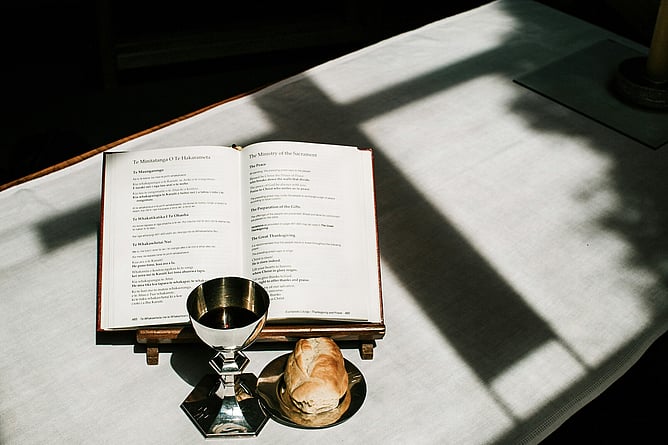
He was the Word that spake it,
He took the Bread and brake it;
And what the Word did make it,
That I believe and take it.
These four lines have wandered through English history, sometimes placed in the mouth of a queen, sometimes at the pen of a poet. Their appeal is obvious. In an age that argued fiercely about what happens at the altar — transubstantiation here, consubstantiation there, and a good deal of nervous hedging in between — this little epigram simply steps aside from the quarrel. It listens instead to Christ’s own actions: the Word who speaks, the hands that break, and the promise that invites trust.
During the reign of Roman Catholic Mary, (1553-58), her sister Lady Elizabeth (later Queen) lived under deep suspicion — watched, questioned, and at times imprisoned. She needed to affirm her faith without provoking the authorities who could so easily turn against her. The poem’s strength lies in its restraint: no metaphysics, no diagrams, no attempt to peer behind the veil. Just Christ’s word, Christ’s action, and the believer’s quiet assent.
John Donne, to whom the epigram is also attributed, knew something of suspicion himself. Born and raised a Roman Catholic, he grew up in an England where loyalty was scrutinised and religious identity could be dangerous. His later conversion to the Church of England did not remove all the unease; it simply changed its shape. Donne understood how theological nuance could be read politically. Perhaps that is why the lines suit him so well. Donne’s mature Anglican theology resisted the temptation to define the Eucharist too tightly. He trusted that Christ’s presence at the altar is not improved by human explanation. What matters is the encounter — the worshipper drawn into Christ’s self‑giving, the bread and wine becoming the place where God meets us in mercy.
For us, the epigram still carries weight. It reminds us that the Eucharist is not a puzzle to be solved but a gift to be received. Christ speaks; Christ breaks; Christ gives. We come with open hands, trusting that what He makes of the bread and wine is enough for the journey we are on. In a world that loves certainty and dislikes mystery, these lines offer a gentler wisdom: let Christ be Christ, let the sacrament be the sacrament, and let faith rest in the One who calls us to the table.