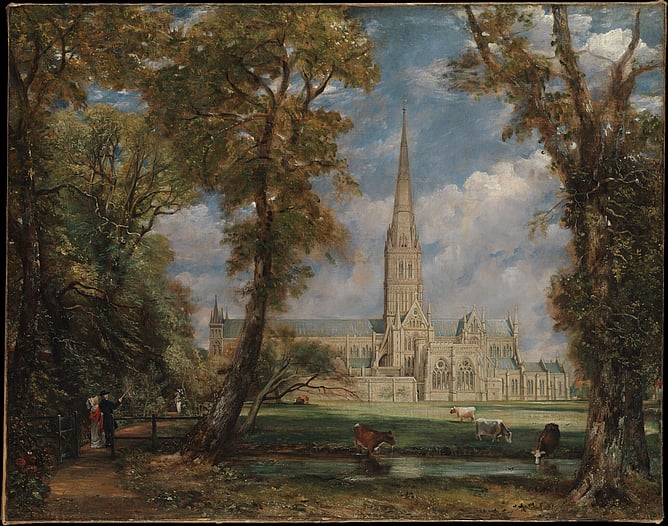
(Based on a Yorkshire saying: “Tha can’t get owt from nowt”)
There’s an old Yorkshire proverb that insists, with typical bluntness,
“Tha can’t get owt from nowt” -- You can’t get something from nothing.
And in one sense, it’s true.
Cathedrals rise from quarried stone; tables come from felled forests;
everything we build begins with something taken, shaped, or rearranged.
Creation, it seems, always has a cost.
But there is another kind of making — quieter, gentler, and strangely God‑like.
Constable didn’t dismantle Salisbury Cathedral to paint it.
Handel didn’t quarry rock to compose the Hallelujah Chorus.
Shakespeare didn’t destroy one play to write another.
Their raw materials were not stone or timber, but imagination, memory, longing,
and that mysterious spark we call inspiration.
Where do these come from?
What quarry yields beauty, or truth, or compassion? What forest produces hope?
Perhaps this is where the Yorkshire proverb falters.
For in the realm of the spirit, we sometimes do see something arise from nothing:
a melody that wasn’t there before, a story that suddenly takes shape,
a kindness offered that no one demanded.
These are not acts of destruction but gifts of grace —
small echoes of the God who creates from nothing and calls light out of darkness.
We cannot create worlds, but we can create beauty.
We cannot speak galaxies into being,
but we can speak encouragement, forgiveness, and love.
And maybe that is our touchstone:
the place where human creativity brushes against the divine.
So perhaps, after all, “Tha can get owt from nowt” —
at least when the raw material is the human heart,
and the spark is God’s own Spirit.